 Cookie preferences
 English
 Español
 Français

Halal Sweets Wholesale for the UAE and the Gulf
Certified Halal Sweets from Spain for the UAE and the Gulf
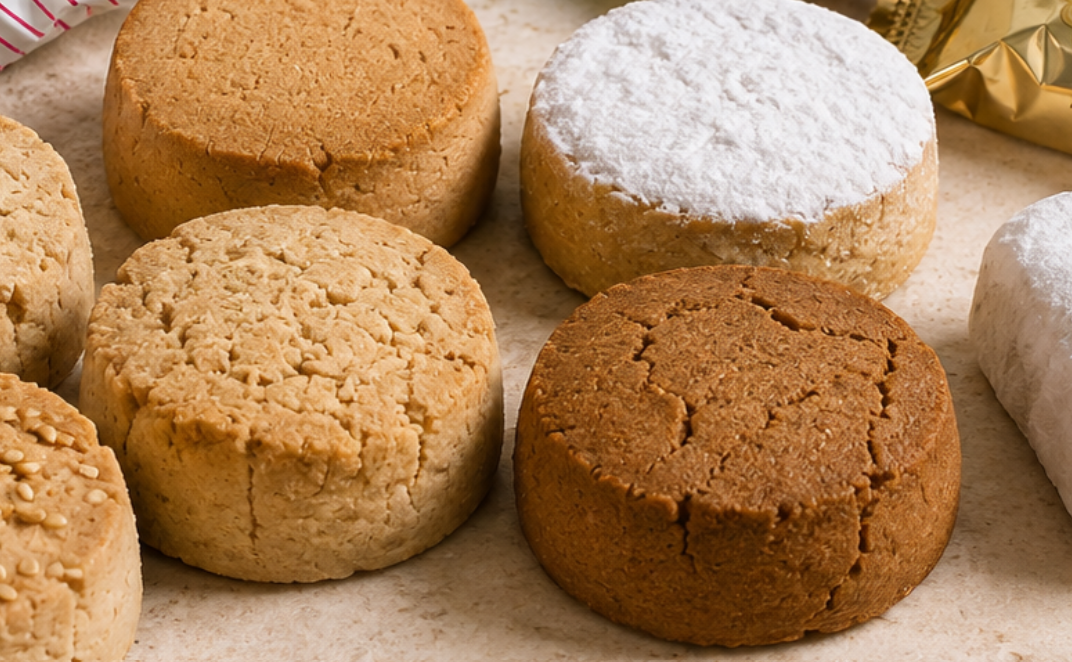
The Gulf market offers a growing opportunity for Spanish halal sweet manufacturers and distributors. The combination of recognised halal certification, Spanish confectionery heritage, retail-friendly packaging formats and a long shelf life makes mantecados, polvorones and alfajores a promising product category in the United Arab Emirates, Saudi Arabia and other GCC markets.
A Market That Buys Sweets All Year Round
The GCC bakery and confectionery market is worth approximately USD 9–9.4 billion and is growing at around 6% annually, with projections indicating that it will exceed USD 15 billion at the beginning of the next decade. Saudi Arabia alone accounts for more than 55% of regional food consumption, while the UAE serves as a re-export hub for the rest of the Gulf, East Africa and South Asia.
Three market trends are particularly relevant for buyers and importers:
- Ramadan retail displays have become a category of their own. Major retail chains set up dedicated displays and prioritise premium SKUs during the month. Carrefour, part of the Majid Al Futtaim Group, operates more than 465 stores and serves approximately 770,000 shoppers daily.
- Online sales are becoming increasingly important. Online grocery sales grew by 29% in the UAE and 46% in Saudi Arabia in 2024. Biscuits and individually wrapped sweets perform well in this channel because they withstand transportation.
- The free-from segment is growing fastest. Sugar-free, gluten-free and plant-based product lines are expanding across the Middle East at approximately 8% annually, well above the rate for conventional products.
Muslim consumers enjoy sweets during tea time, at family gatherings and in the majlis, with a pronounced peak during Eid al-Adha. For distributors, this represents an opportunity to generate sales throughout the year, rather than relying solely on a six-week seasonal campaign.
Which Halal Certification Is Accepted in the UAE and Saudi Arabia?
When exporting halal sweets to the Gulf, certification is one of the key considerations. It is important to distinguish between the requirements that products must meet and those that apply to the bodies issuing the certificates.
| Standard | What it regulates | Who it applies to |
|---|---|---|
| GSO 2055-1 (in the UAE: UAE.S GSO 2055-1) | Halal food product requirements, including ingredients, handling, storage and labelling. | The manufacturer and its product. |
| GSO 2055-2 (UAE.S 2055-2) | Requirements for halal certification bodies. | The organisation issuing the certificate. |
Therefore, it is not enough for a product to comply with GSO 2055-1. The certificate must be issued by a body accredited in accordance with GSO 2055-2 and accepted by the authorities in the destination country. A halal certificate issued by an unrecognised body may not be valid for importation.
United Arab Emirates
The Ministry of Industry and Advanced Technology (MOIAT), which took over the responsibilities of the former ESMA, oversees the national halal framework, administers the Halal National Mark and maintains the register of recognised certification bodies. Accreditation is granted through the EIAC (Emirates International Accreditation Centre) and the ENAS system.
For non-meat products, halal certification is not mandatory in itself. However, if the packaging carries a halal claim or logo, it must be supported by a certificate issued by a body recognised by MOIAT.
Furthermore, the Food Code requires the imported product to match the information on the certificate exactly, including the product name, brand, specifications and manufacturing plant address.
Saudi Arabia
The SFDA (Saudi Food and Drug Authority) applies stricter requirements. Since the October 2023 circular, halal certificates must come exclusively from bodies recognised by the Saudi Halal Center. Its list of recognised bodies can be consulted at halal.gov.sa.
The requirement was extended to composite product categories such as bakery products and doughs, confectionery and chocolate, ice cream, dairy products and dairy alternatives.
One particularly important rule for this category is that if the packaging displays a halal logo, the product requires certification even if its formulation contains no ingredients of animal origin.
A halal consignment certificate may also be required for certain regulated shipments.
What This Means for Dulces Gamito
The halal product line from Dulces Gamito is certified by the Instituto Halal of Junta Islámica, an organisation that has managed the Halal guarantee mark in Spain since 2003.
Several factors stand out for Gulf importers:
- The Instituto Halal is accredited by EIAC under the UAE.S/GSO 2055-2 standard and is listed among the certification bodies registered for exports to the UAE.
- Its certificates are also recognised by the SFDA in Saudi Arabia, as well as by BPJPH and MUI in Indonesia, JAKIM in Malaysia and SMIIC.
- The Dulces Gamito certificate incorporates the GSO 2055-1 standard, a technical reference for marketing halal sweets in Bahrain, Kuwait, Oman, Qatar, Saudi Arabia and the UAE.
When a recipe is developed from scratch using 100% plant-based raw materials, with no pork fat or alcohol, the risk is eliminated at source rather than managed through exceptions.
In 2004, Dulces Gamito developed the world's first 100% plant-based mantecado with halal certification and has more than twenty years of experience exporting this product line. This represents a complete reformulation, not a last-minute adaptation.
An additional commercial benefit is that the same product may appeal to vegetarian consumers and people looking for plant-based alternatives. In a market with more than 200 nationalities, a single SKU can appeal to several consumer groups and simplify product assortment.
Checklist: Documentation, Labelling and Logistics for Exporting Halal Sweets
Documentation, labelling and logistics are key factors in preventing delays when importing food products into the Gulf.
Required Documentation
- Valid halal certificate covering the specific product reference.
- Halal consignment certificate, if required for the product category in the destination market.
- Technical data sheet and allergen information sheet.
- Certificate of origin.
- Commercial invoice and bill of lading.
- Product registration by the local importer.
Registration in the United Arab Emirates
- The federal ZAD system (Ministerial Decree 239/2018), which must be completed before the product is marketed.
- In Dubai, label assessment through Montaji / FIRS with the Dubai Municipality.
- In Abu Dhabi, involvement of ADAFSA.
Registration in Saudi Arabia
In Saudi Arabia, the product must be registered with the SFDA.
Labelling Requirements for the Gulf Market
Labelling must comply with applicable standards, including GSO 9, GSO 150 and GSO 2233.
- Arabic is mandatory on consumer packaging. English may also be included but cannot replace Arabic.
- Product name.
- Ingredient list.
- Allergen information.
- Nutritional information in tabular format.
- Net weight.
- Country of origin.
- Manufacturer details.
- Manufacturing and best-before dates printed on the original packaging.
- Halal certification and 100% plant-based logos consistent with the information stated on the certificate.
Handwritten dates, dates added by stickers and double-dating are prohibited and are common reasons for product rejection.
Minimum Remaining Shelf Life at the Port of Arrival (MRSL)
GCC customs authorities require a minimum remaining shelf life at the time of importation.
- Saudi Arabia: As a general rule, at least 50% of the declared total shelf life must remain. If the total shelf life is less than six months, at least three months must remain.
- It is advisable to confirm the current requirements in each destination market before scheduling production.
Dry confectionery has a clear advantage in this respect: it does not require a cold chain, is suitable for sea freight and has a long shelf life. This makes it easier to meet MRSL requirements and improve unit costs compared with products such as chocolate, fresh bakery goods or filled dates.
There is also an interesting alignment between production and demand seasons. The main mantecado production season in Spain runs from September to December, while peak demand in the Gulf occurs during Ramadan and Eid, between February and May.
For importers, this means available production capacity, shorter lead times and greater flexibility when negotiating formats and prices to meet market demand.
Why Spanish Sweets Perform Well in the Gulf Market
Andalusian mantecados, polvorones and alfajores have direct roots in Andalusi confectionery traditions. Ingredients such as cinnamon, sesame, almonds, anise, coconut and icing sugar form part of a flavour profile that may be familiar to consumers in the region.
The word alfajor itself entered the Spanish language from Arabic.
This gives these products an attractive commercial position: European origin and PGI status as indicators of premium quality and food safety, combined with a familiar flavour profile that encourages repeat purchases.
Consumers may try the product out of curiosity and then make it a regular purchase because of its familiar taste.
Iftar and Suhoor
The crumbly, melt-in-the-mouth texture, individually wrapped portions and the ability to serve individual pieces without opening the entire box make these sweets easy to incorporate into eating occasions after breaking the fast.
Eid Gifts
Lithographed gift boxes, baskets, tins and corporate gift editions allow Spanish halal sweets to be positioned as a distinctive alternative to traditional chocolates.
Majlis and Gahwa
The platter served alongside cardamom coffee can include sesame, cinnamon and almond varieties. This everyday consumption occasion can be particularly valuable in turning a new product into a regular retail listing.
B2B Formats for Spanish Halal Sweets
Dulces Gamito is a family-owned confectionery business based in Estepa, Seville, founded in 1965. It is a member of the Regulatory Council for the PGIs “Mantecados de Estepa” and “Polvorones de Estepa”, has been exporting since 1993 and operates under three proprietary brands: Gamito, La Cabalgata and La Unión.
Available Halal Product Range
| Product | Varieties | Packaging |
|---|---|---|
| Halal mantecados | Cinnamon, lemon, coconut, chocolate | Individually wrapped flow pack |
| Halal polvorones | Traditional, almond | Individually wrapped flow pack |
| Halal alfajores | Traditional | Individually wrapped flow pack |
| Halal assorted selection | Mixed assortment | 600 g lithographed gift box |
| Special product lines | Sugar-free, gluten-free, biscuits | Available on request |
All products are 100% plant-based, contain no pork fat or alcohol, and display the halal guarantee logo and a visible 100% plant-based label.
How to Start Importing Spanish Halal Sweets
The market entry process can be organised into four steps:
- Samples and catalogue. Samples are sent with a halal certificate and a complete technical data sheet for tasting and internal evaluation.
- Document verification. The certificate's scope is checked against the MOIAT/ENAS or Saudi Halal Center register, and the bilingual label is prepared.
- Registration in the destination market. The importer's team handles ZAD / Montaji / SFDA registration using the documentation provided. This process is completed once per product reference.
- First order. Packaging format, Incoterms and delivery schedule are agreed, with the remaining shelf life calculated to meet the destination market's MRSL requirements.
Request the Dulces Gamito B2B Catalogue and Price List
If you are an importer, distributor, retailer or purchasing manager interested in reviewing prices, formats and export terms for the Dulces Gamito halal range, you can request commercial information, a catalogue and samples.
You can also find further information about halal certification here:
Dulces Gamito Halal Certificate
In the Gulf, sweets are more than an indulgence: they represent hospitality, gifting and family memories. A product that arrives with the correct certificate, approved labelling and sufficient remaining shelf life can become a reliable, regularly purchased product, with demand peaks during Ramadan and the two Eid celebrations.
When the recipes also share roots with the region's own confectionery traditions, the selling point is no longer just the product's origin but its flavour. And flavour is what brings customers back for a second purchase.
Frequently Asked Questions About Halal Sweets for the Gulf
Is the Instituto Halal certificate valid in the United Arab Emirates?
The Instituto Halal is accredited by EIAC under the UAE.S/GSO 2055-2 standard and is listed among the bodies registered for exports to the UAE. It is the only Spanish halal certification body with this accreditation. As registers and certification scopes are updated, we recommend checking the current status in the MOIAT/ENAS register before each transaction.
What about Saudi Arabia?
The Instituto Halal's certificates are recognised by the SFDA. Since 2023, the SFDA has required halal certificates to be issued exclusively by bodies recognised by the Saudi Halal Center, whose public list is updated regularly.
If a product is 100% plant-based, does it need halal certification?
For non-meat products, certification is not always mandatory based solely on the product's composition. However, if the packaging carries a halal logo or claim, certification is required in both the UAE and Saudi Arabia.
Furthermore, without that logo, the product loses one of the key commercial selling points that makes it attractive to certain buyers and consumers in the Gulf.
What exactly does GSO 2055-1 mean?
GSO 2055-1 is the standard that establishes halal food requirements, including ingredients, handling, storage and labelling. It is a common technical reference in Bahrain, Kuwait, Oman, Qatar, Saudi Arabia and the UAE.
It is important to distinguish it from GSO 2055-2, which governs the requirements applicable to certification bodies.
Do the sweets contain alcohol in their flavourings?
No. The halal product line is formulated without alcohol or pork fat. This is particularly relevant in European confectionery, where certain commercial flavourings may use ethanol as a carrier.
Do halal sweets require a cold chain?
No. They are dry products that remain stable at room temperature, are suitable for sea freight and have a shelf life sufficient to meet GCC remaining-shelf-life requirements.
```
Related posts
-
 Christmas Carols
Christmas is a time full of joy, family gatherings, and traditions that have endured over the centuries. Among these...Read more
-
 Homemade Mantecados Recipe: The Traditional Christmas Sweet
Christmas brings with it the unmistakable aroma of traditional sweets, and one of the most iconic in Spain is the...Read more
-
 Spanish Christmas Traditions: A Look at Festive Customs
Christmas in Spain is a time of year marked by tradition, family and joy. The streets are filled with Christmas...Read more
-
 What are mantecados?
Have you ever wondered what mantecados are and where they come from? Traditional Spanish pastries are full of...Read more
-
 History and Origin of Christmas: A Journey Through Time and Tradition
Christmas, a celebration that envelops us in the magic of twinkling lights, laughter, and the sweet fragrance of...Read more
Leave a comment